BHASHINI Targets India’s Language Divide, Showcases Multilingual AI Solutions for Accessible Research
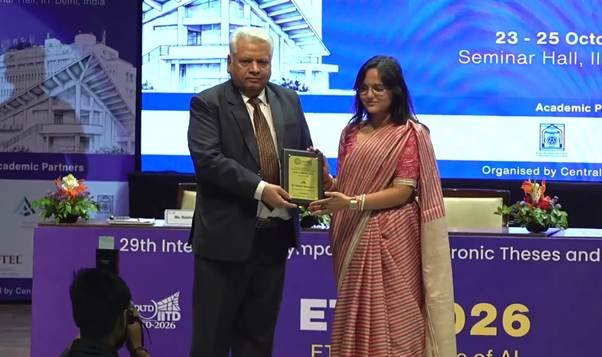
India’s digital governance agenda is expanding beyond online service delivery towards making knowledge accessible across linguistic boundaries. The Digital India BHASHINI Division (DIBD), under Digital India Corporation and the Ministry of Electronics and Information Technology (MeitY), showcased multilingual artificial intelligence solutions at the 29th International Symposium on Electronic Theses and Dissertations (ETD-2026), held at IIT Delhi from October 23 to 25.
The initiative addresses a structural barrier in higher education and research: valuable academic material often remains inaccessible to readers who do not understand the language in which it is written. BHASHINI demonstrated how AI-powered translation, speech recognition and document-processing technologies could help universities, libraries and research repositories expand access to scholarly content.
Highlights
* Multilingual Reach: BHASHINI supports text services in 36 Indian languages, voice services in 23 Indian languages and 35 international languages.
*Real-Time Translation: Shrutlekh demonstrated live speech transcription with simultaneous translation, offering potential applications in lectures, seminars and academic discussions.
* Large-Document Processing: BHASHINI Pragati, a translation workbench developed for the Comptroller and Auditor General of India (CAG), supports documents ranging from 100 to 500 pages with quality checks and data-security considerations.
* Digital Governance Scale: The platform has recorded more than 10 billion cumulative AI inferences, while its website translation plugin enables multilingual access across more than 800 government websites.
BHASHINI highlighted the potential integration of multilingual AI into research repositories such as Shodhganga, maintained by INFLIBNET and university libraries. AI-powered workflows could help translate theses, dissertations and specialised research documents while preserving document structure and technical terminology. Optical character recognition (OCR) can also extract text from scanned documents, improving the accessibility of digitised research material.
The wider ecosystem includes BhashaDaan which enables citizens to contribute language data and Granthika which supports the digitisation and preservation of books, manuscripts, folk literature and oral histories. These capabilities could strengthen India’s digital knowledge infrastructure by widening access to both contemporary research and cultural resources.
Governance Impact: From Digital Access to Knowledge Inclusion
The significance of BHASHINI lies in its potential to make language a bridge rather than a barrier to education and research. Students, scholars and institutions could benefit from improved access to research produced in languages beyond their own, encouraging wider knowledge-sharing and more inclusive academic participation.
However, specialised scientific translation requires contextual accuracy, reliable terminology and human verification. Institutional adoption, quality assurance and measurable improvements in accessibility will be essential to translate AI demonstrations into dependable services.
Governance Bharat Perspective: Multilingual AI can become a critical layer of India’s digital public infrastructure. Its long-term value will depend not merely on the number of languages supported but also on translation quality, institutional integration and the extent to which knowledge becomes accessible to citizens across linguistic and educational backgrounds.