Voyager 1 Approaches One Light-Day From Earth Setting a New Benchmark in Deep-Space Exploration
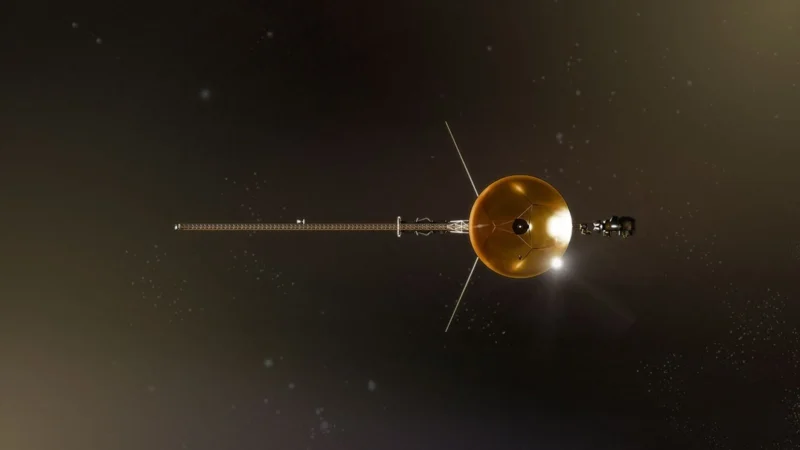
NASA’s Voyager 1 spacecraft is approaching one of the most extraordinary milestones in space exploration: travelling a distance equivalent to one light-day from Earth. The achievement would mark a historic distance benchmark for a human-made object operating in interstellar space, highlighting the extraordinary longevity of NASA’s deep-space exploration programme.
Launched on September 5, 1977 Voyager 1 was originally designed to study Jupiter and Saturn. After completing its planetary exploration mission, the spacecraft continued its journey beyond the heliosphere and entered interstellar space in 2012, becoming the first human-made spacecraft to do so.
One light-day represents the distance travelled by light in 24 hours, approximately 25.9 billion kilometres . At this distance, a radio signal travelling at the speed of light would require roughly 24 hours to reach Earth with another 24 hours needed for a response to return.
The milestone underscores the remarkable engineering behind Voyager 1 which continues to transmit scientific information despite operating for nearly five decades in an extremely harsh environment. Its observations provide valuable insights into interstellar plasma, cosmic rays and the boundary between the Sun’s influence and interstellar space.
The Deeper Significance
Voyager 1’s journey demonstrates how long-term scientific investment can generate discoveries far beyond the original objectives of a mission. Its continued operation also highlights the importance of resilient spacecraft engineering, advanced communication systems and sustained institutional support for frontier research.
For NASA, the approaching one-light-day threshold is not merely a distance record; it represents a defining achievement in humanity’s effort to explore beyond the boundaries of the Solar System.