Odisha’s Integrated Science and Technology Ecosystem to Drive New Opportunities for Science-Based Development
The Government of India is advancing an integrated science and technology framework for Odisha by bringing together the State’s rare earth resources, marine biodiversity, biotechnology ecosystem, space capabilities and network of scientific institutions. The proposed approach seeks to strengthen research, innovation and technology-led economic development while promoting sustainable utilisation of natural resources.
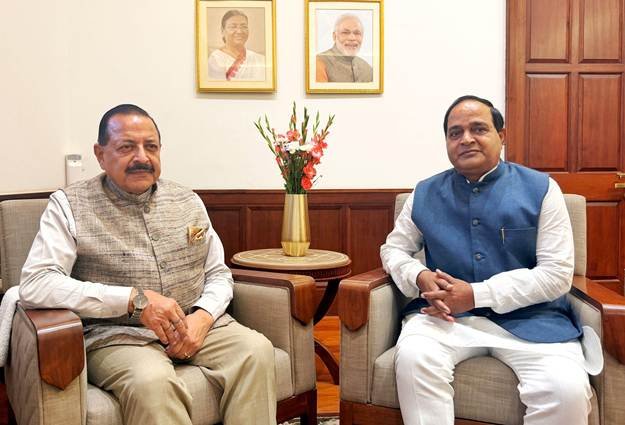
Union Minister Dr. Jitendra Singh held discussions with Odisha’s Science and Technology Minister Shri Krushna Chandra Patra on initiatives aimed at strengthening the State’s scientific and technological ecosystem. The deliberations focused on marine biotechnology, life sciences, critical minerals, space applications, scientific infrastructure and coastal development.
A key outcome of the discussions was the proposed expansion of the Institute of Life Sciences (ILS), Bhubaneswar, associated with the Department of Biotechnology, with provision for an additional 50 acres of land by the State Government. The expanded institutional capacity is expected to strengthen research in life sciences and biotechnology and support applications linked to the Bio-E3 framework, including the economy, environment and employment.
The Odisha Marine Biotechnology Research and Innovation Corridor (OMBRIC) is also being developed as a collaborative platform connecting leading academic and research institutions. Its existing partnerships include IIT Bhubaneswar, Berhampur University, Fakir Mohan University, NIT Rourkela, IISER Berhampur and ILS Bhubaneswar. Greater alignment with the Ministry of Earth Sciences, CSIR and the Department of Biotechnology is expected to facilitate advanced research and industrial innovation based on Odisha’s marine resources.
The State’s role in the emerging Rare Earth Corridor is another strategic component. The Union Budget 2026-27 has proposed dedicated rare earth corridors in Odisha, Kerala, Andhra Pradesh and Tamil Nadu, with emphasis on mining, processing, research and manufacturing. The initiative is aimed at developing an integrated domestic value chain for rare earth elements and strengthening India’s capabilities in advanced materials and strategic technologies.
The discussions also explored strengthening Odisha’s space ecosystem, including closer collaboration with ISRO and the potential development of space research and manufacturing facilities through the PPP model. Such an ecosystem could facilitate cooperation among government institutions, research organisations and industry in space applications, technology development and manufacturing.
Odisha’s extensive coastline and marine resources further provide opportunities under the Deep Ocean Mission, marine science, fisheries and coastal economic development. The State’s proposed deep-sea fisheries initiatives could support stronger value chains and expand opportunities within the blue economy.
The proposed Science City in Odisha was also discussed as a public-facing initiative to promote scientific awareness, experiential learning and greater engagement of youth with science and technology.
The integrated framework reflects a whole-of-government and centre-state collaborative approach, linking scientific research with economic development, strategic technologies and sustainable resource management. By converging marine biotechnology, rare earths, earth sciences, space technology and life sciences, Odisha has the potential to emerge as a significant science-driven development hub on India’s eastern coast.
The discussions also highlighted Odisha’s participation in the “Swachh Sagar, Surakshit Sagar” campaign, reinforcing the importance of public participation, coastal cleanliness and marine environmental protection.
Overall, the proposed initiatives represent a strategic convergence of science, technology, natural resources and innovation, supporting India’s objectives of technological self-reliance, sustainable development and a stronger knowledge-based economy.