Chhath Puja Exposes Delhi’s Yamuna Pollution Crisis Amid Political Blame Game
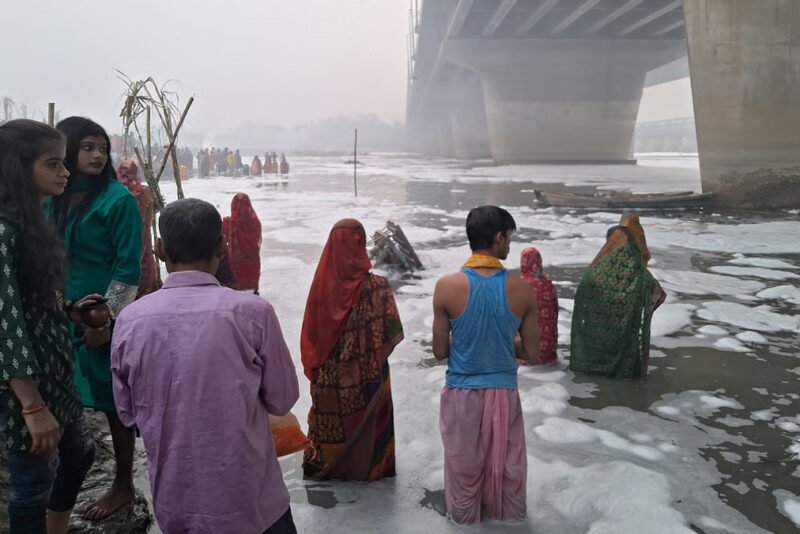
The continuing pollution of the Yamuna through Delhi has once again brought the capital’s environmental governance under scrutiny ahead of Chhath Puja. Despite repeated political exchanges, government assurances and pollution-control initiatives, the river’s Delhi stretch continues to face serious water-quality challenges, raising concerns over the safety of devotees participating in religious rituals.
Chhath Puja, during which devotees offer prayers to the setting and rising sun while standing in water highlights the importance of clean river water and accessible riverbanks. However, sewage discharge, untreated wastewater and accumulated waste continue to threaten the Yamuna’s ecological condition.
The issue has also become a recurring political flashpoint with competing allegations between political parties over responsibility for cleaning the river. Yet, the persistence of pollution exposes a deeper governance problem: political commitments have not translated into sustained environmental improvement.
The seriousness of the crisis is reflected in water-quality assessments. According to the Delhi Pollution Control Committee’s August 2026 assessment, faecal coliform levels at Asgarpur reached 36,000 MPN per 100 ml against the desirable bathing-water limit of 500. Biochemical Oxygen Demand also stood at 16 mg/l, considerably above the prescribed benchmark of 3 mg/l.
The pollution burden is further aggravated by wastewater entering major drains. Official records indicate that nearly 295 million gallons per day of untreated sewage from neighbouring Haryana and Uttar Pradesh enters Delhi’s Najafgarh and Shahdara drain networks.
River Rejuvenation: The Implementation Gap
Measures under consideration include diverting approximately 500 cusecs of Ganga water into the Yamuna at Wazirabad. Additionally, 29 decentralised sewage treatment plants are targeted for completion by January 2028 with associated sewer-network work expected by June 2028.
The recurring pollution crisis demonstrates that river rejuvenation cannot depend on temporary arrangements before religious festivals or political announcements. Effective sewage treatment, restoration of ecological flow, interstate coordination and strict enforcement against untreated discharge must become permanent governance priorities.
For Delhi, the Yamuna is not merely an environmental concern but also a question of public health, religious dignity and institutional accountability. The real test of environmental governance will be whether the river becomes cleaner throughout the year rather than only during politically sensitive occasions.