
Japan Looks to Uttar Pradesh: A New Chapter in the State’s Growth Story
Durgesh Upadhyay
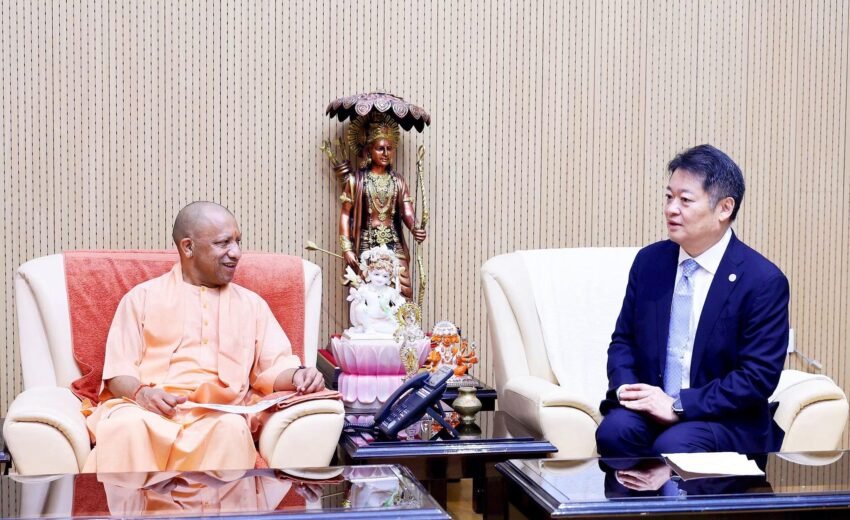
Having watched Uttar Pradesh’s economic and administrative journey from close quarters over the past several years, I believe the recent visit of a Japanese delegation to the state deserves attention beyond the usual headlines about investment. The delegation’s meetings with Chief Minister Yogi Adityanath and senior officials suggest that the relationship between Uttar Pradesh and Japan is moving towards a more serious and long-term economic engagement.
Such high-level interactions were relatively rare before 2017, when concerns over law and order, infrastructure and the overall business environment often discouraged foreign investors from exploring opportunities in the state.
What makes the recent engagement significant is how considerably the perception of Uttar Pradesh among investors has changed. Not long ago, discussions about investing in the state would invariably begin with concerns about infrastructure, connectivity and the ease of dealing with government departments. Today, the conversation is increasingly focused on the opportunities Uttar Pradesh can offer. In my view, this represents a major shift, driven in large measure by decisive leadership. Chief Minister Yogi Adityanath has also taken a personal interest in attracting and facilitating investment.
Much of this change is visible on the ground. New expressways, airports, industrial corridors, logistics infrastructure and emerging investment destinations have altered the way businesses look at the state. Equally important has been a change in the working style of the administration. The Yogi Adityanath government has made investment facilitation and time-bound decision-making important components of its economic agenda.
The Japanese interest comes at an appropriate time.
Japan has considerable experience in areas where Uttar Pradesh now wants to build greater strength—advanced manufacturing, engineering, quality control, technology, skill development and efficient production systems. Uttar Pradesh, in turn, offers what few markets can match: scale. Its large population, growing consumer market, young workforce and improving connectivity make it a natural destination for companies looking beyond traditional industrial centres.
But Uttar Pradesh should be careful not to view this relationship merely in terms of the quantum of investment it can attract. The bigger opportunity lies in integrating Japanese expertise into the state’s wider industrial ecosystem.
Japanese companies operating in Uttar Pradesh, for instance, could be encouraged to develop local vendor and supplier networks. This would enable MSMEs in the state to become part of larger manufacturing chains. With appropriate support in technology, quality standards and management practices, many of these enterprises could eventually find a place in Japanese and global supply chains.
Skill development is another area where both sides can gain. Instead of creating training programmes disconnected from industry requirements, Uttar Pradesh could work with Japanese companies to establish specialised centres around sectors where actual investments are coming up. Training young people for specific industrial requirements would make employment outcomes far more meaningful.
There is also a cultural connection that deserves greater attention. Uttar Pradesh has a special place in the Buddhist circuit, while Japan has a deep and enduring interest in Buddhist heritage. Sarnath, Varanasi and other destinations can become part of a broader tourism and cultural partnership. Academic exchanges, university collaborations and programmes for young people could further strengthen these ties.
The next few years will be important. Investment proposals and MoUs are useful indicators of interest, but their real value will become evident only when projects take shape, local employment is generated and Uttar Pradesh-based companies begin to benefit from the emerging business ecosystem.
This is also where the Yogi Adityanath government will face its next challenge. Attracting investors is only the first part of the job. Retaining their confidence requires consistency in policy, quick resolution of problems and an administration that remains engaged even after an investment announcement has been made.
Having seen the state’s investment narrative evolve, I believe this is perhaps the most important change of all. Uttar Pradesh is no longer simply asking investors to come and explore its potential. It is increasingly approaching them with a clearer proposition about what the state can offer.
Japan could become an important partner in that next phase.
If the present interest is followed by sustained investment, technology partnerships, stronger local supply chains and better skills, the UP-Japan relationship could have an impact far beyond individual projects. It could help shape a more competitive manufacturing base and give Uttar Pradesh a stronger place in global production networks.
The Japanese delegation has created considerable interest. What matters now is what happens after the delegation returns home. The success of this relationship will ultimately be measured not in meeting rooms, but in factories, businesses, skills and jobs created here in Uttar Pradesh.
( The writer is an Advocate at the High Court, Lucknow, and a political commentator )