
New Development Bank and Private Capital Mobilisation: A Governance Perspective

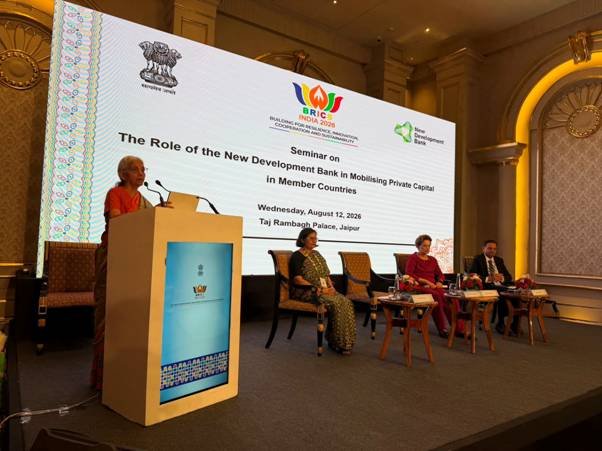
Union Minister for Finance and Corporate Affairs Nirmala Sitharaman emphasised the strategic role of multilateral development banks in mobilising private capital for sustainable infrastructure and development during a seminar on “The Role of the New Development Bank in Mobilising Private Capital in Member Countries” held in Jaipur on August 12, 2026, alongside the BRICS Finance Ministers and Central Bank Governors meeting.
Strengthening the Development Finance Ecosystem
The Finance Minister highlighted that BRICS economies are among the key engines of global economic growth but face common structural challenges in attracting private capital at scale. These challenges extend beyond capital availability to include investor confidence, risk management, policy predictability, financial stability and credible long-term institutional frameworks.
Multilateral development banks can address these constraints by de-risking investments, improving project bankability and strengthening investor confidence. Their role is therefore increasingly important in creating an enabling environment for public-private investment partnerships.
India’s Infrastructure-Led Governance Approach
India’s development strategy demonstrates how sustained public capital expenditure can act as a catalyst for private investment rather than substitute for it. Increased public investment over the past decade has supported the development of national assets across highways, railways, ports, logistics, digital infrastructure and energy networks.
Key policy instruments supporting this approach include:
– Viability Gap Funding (VGF) for economically constrained but socially important projects.
– Hybrid Annuity Model (HAM) for balanced risk sharing in road infrastructure.
– Credit enhancement mechanisms to improve project bankability.
– Infrastructure Investment Trusts (InvITs) to recycle capital and attract long-term institutional investors.
– National Infrastructure Pipeline (NIP) to provide greater visibility and investment clarity.
– PM Gati Shakti National Master Plan to improve multimodal connectivity, coordination and infrastructure efficiency.
Budgetary Measures to Catalyse Private Investment
The Union Budget 2026-27 has further focused on creating infrastructure opportunities capable of attracting private investment. Key measures highlighted during the seminar include the development of new Dedicated Freight Corridors, High-Speed Rail Corridors, National Waterways and a Coastal Cargo Promotion Scheme.
These initiatives can contribute to lower logistics costs, improved connectivity, greater economic efficiency and stronger participation of private capital in infrastructure development.
BRICS Cooperation and the Role of NDB
The discussion underlined the potential of the New Development Bank (NDB) to strengthen development finance across BRICS member countries. Greater cooperation between governments, multilateral institutions and private investors can help create scalable financing models for infrastructure, climate action, energy transition and other development priorities.
The central governance message is that successful private capital mobilisation requires more than financial resources. It depends on institutional credibility, predictable policies, transparent project pipelines, appropriate risk allocation and long-term investment frameworks.
Way Forward
The seminar reinforced the principle that the future of development finance lies in partnership-driven governance. Governments can provide policy stability and public capital, multilateral institutions can reduce investment risks and strengthen project structures, while private investors can contribute capital, technology, expertise and operational efficiency.
A coordinated approach among these stakeholders can help BRICS economies build resilient infrastructure ecosystems and accelerate sustainable, inclusive and investment-led economic growth.
Conclusion: India’s experience demonstrates that well-designed public investment, structural reforms and innovative financing mechanisms can create a strong foundation for private capital mobilisation. Strengthening the NDB’s catalytic role can further support BRICS countries in addressing infrastructure financing gaps and advancing long-term development objectives.